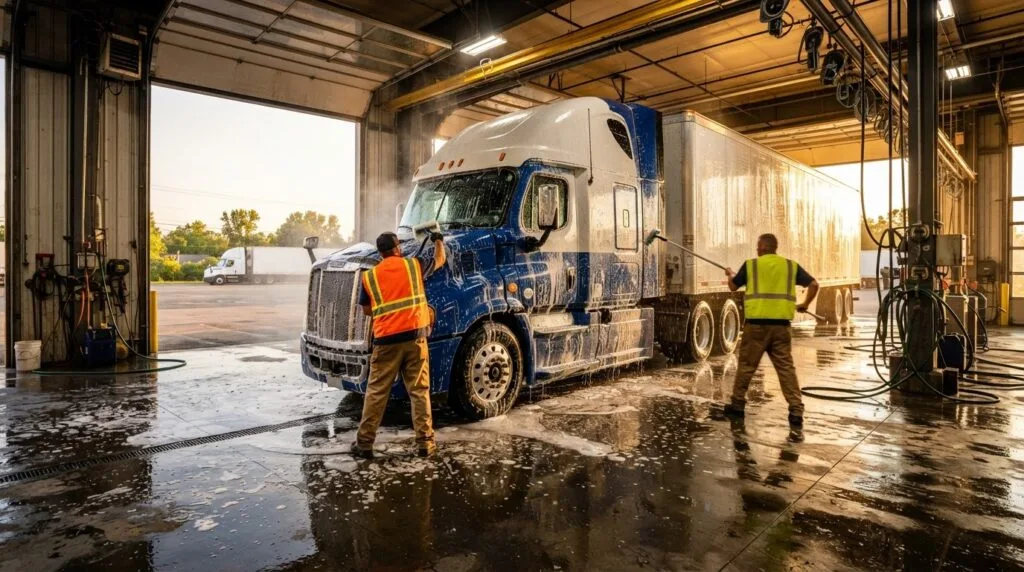

Quick answer. A recurring truck wash is a repeat job that runs off a saved template instead of somebody’s memory. You build the template once, attach it to a licence plate, and the next booking appears on the agreed cycle whether or not anyone thinks about it. Missed washes are rarely a capacity problem. They are a problem of nobody owning the rebooking.
Most truck washes lose recurring work the same way. A fleet agrees to send its tractors round every three weeks, the planner writes it in a shared calendar, and for four months it runs beautifully. Then the planner takes a fortnight off, two vehicles slip, nobody chases them, and by autumn the fleet is going somewhere closer to the depot. Nothing went wrong with the wash itself.
Why do recurring truck washes get missed?
They get missed because rebooking depends on a person remembering, and the amount to remember grows faster than anyone expects. A single fleet of forty tractors on a three-week cycle is roughly thirteen washes a week to keep straight. Three fleets like that and you are tracking forty moving dates in your head, in a spreadsheet, or in a calendar nobody else can read.
The failure is quiet, which is what makes it expensive. A customer who is unhappy tells you. A customer whose wash simply never got booked drifts, and by the time you notice the drop in volume you are having a retention conversation rather than an operational one. That is the same pattern we described in truck wash customer management, arriving from a different direction.
There is a second reason, and it is worth being honest about. Rebooking is nobody’s actual job. It sits between the person on the lane and the person doing the invoicing, and work that sits between two roles gets done when things are quiet, which is exactly when it is least likely to be remembered.

What is a wash template, and how is it different from a booking?
A booking is one wash on one date. A template is the specification that booking is made from, saved once and reused. The distinction matters because it separates what a wash is from when it happens, and almost every recurring problem sits in the first half.
In practice a template holds the recipe. Nuvix describes it as encapsulating “every detail, from bay assignment and chemical dosing to scripted operator steps and add-on prompts”, so an attendant can set up the job without asking anyone how this particular customer likes it done. Attach the template to a licence plate and the vehicle stops being a generic truck in a queue.
| Ad hoc booking | Template driven | |
|---|---|---|
| Who remembers the next date | A person | The system |
| Who knows the spec | Whoever washed it last time | Anyone on the lane |
| What happens on holiday | It slips | Nothing changes |
| Changing the spec | Tell everyone, hope | Edit once |
Which customers belong on a recurring schedule?
Put an account on a recurring schedule once it has come back three times at a roughly predictable interval. Three is the point at which a pattern is real rather than a coincidence, and it is early enough that you are formalising the habit rather than reacting to its absence.
Some accounts are obvious candidates. Tankers with cleaning obligations, refrigerated trailers, anything running livery that a customer of theirs will see. Those washes are not discretionary, so the interval is already fixed by something other than the weather.
Others are not worth the setup. A haulier passing through twice a year on a specific route is a booking, not a schedule, and building a template for them creates a maintenance job with no payoff. The test is whether you could predict, within a week, when they will next be back.

What should the template actually specify?
Specify everything an attendant would otherwise have to ask about, and nothing that changes between visits. That usually comes down to five things:
- The wash programme. Which tier, which duration, what is included. This is where the template meets your wash programmes, so the price is decided by the programme rather than negotiated on the lane.
- The bay or lane. Some vehicles only fit some bays. Putting it in the template stops the discovery happening with the truck already halfway in.
- Chemical dosing and pressure. The settings that make an aluminium tank come out right and a curtainsider come out wrong.
- The operator steps. Anything this customer expects that is not obvious, such as chassis attention or a particular order of work.
- Add-on prompts. The extras worth offering to this vehicle, so the upsell is a question rather than a memory.
What does not belong in a template is anything that varies. Driver name, arrival time, whether they want it done before eleven. Those belong to the booking, and putting them in the template means editing the template constantly, which is how people stop trusting it.
How do you change a recurring wash without breaking every booking?
Change the template, not the bookings. That is the whole reason for the separation: when you improve a programme or switch a chemical, the update cascades to every bay and every location using that template, and nobody has to be told.
This is also the part operators get wrong when they run recurring work out of a calendar. A calendar entry is a copy. Change the way you wash a fleet and you now have forty copies carrying the old instruction, and you will find the last of them in about six months.
One habit worth keeping alongside it: note why you changed something. Version history tells you what the programme looked like in March. It does not tell you that you added the extra rinse because a customer complained about residue, and that is the fact you will want when someone asks whether you can drop it again.
What happens when the truck does not turn up?
Treat a no show as information rather than an empty slot. One missed appointment is traffic. Three in a row from the same fleet, on a schedule that ran cleanly for a year, is a customer you are about to lose and have been given warning about.
Practically, that means the schedule needs to be visible next to the account rather than only on the day sheet. A lane view tells you today’s gap. The company record tells you this is the third gap, which is the one worth a phone call.
It also means resisting the urge to quietly delete the booking. A cancelled recurring wash that leaves no trace is indistinguishable from a wash that was never scheduled, and you lose the one signal that would have told you something changed.
Questions we get asked
How far ahead should recurring washes be scheduled?
Far enough that a driver can plan around it, not so far that the schedule becomes fiction. Four to six weeks of visible bookings is usually right for a fleet on a two or three week cycle. Beyond that you are mostly generating slots that will be moved.
Can one licence plate have more than one template?
Yes, and it is common. A tractor unit might have a routine exterior wash on a short cycle and a deeper clean a few times a year. Keep them as separate templates rather than one template with conditions in it, because conditions are the thing attendants misread.
Does a recurring schedule mean a fixed price?
Not automatically. The price comes from the wash programme attached to the template, so it moves when you change the programme. If you have agreed a fixed rate with a fleet, that belongs in the billing terms on the company record, where it is visible to whoever invoices.
What is the difference between a template and a subscription?
A template is an operational specification for a repeat job. It is not a prepaid plan or a membership, and Nuvix does not sell washes that way. If you want a fleet on a fixed monthly amount, that is a commercial agreement you record against the account and invoice against, not a product setting.
Should recurring customers get their own lane priority?
Only if you can hold it. Promising a fleet that they never queue and then breaking it on a busy Thursday costs you more than never promising. What you can reliably offer is a known slot at a quiet hour, which is worth more to a planner than vague priority anyway.
Want to see what a fleet’s schedule looks like when nobody has to remember it? Start a free trial and build the first template this week.