
Quick answer. Chemical is rarely your biggest cost and it is almost always your least controlled one. The money is not in the price per drum, it is in dosing that drifts, a programme nobody has reviewed since it was set up, and rewashes that double the spend on a single vehicle. Track cost per wash against the programme and the drift becomes visible in a week.
Ask an operator what a wash costs in chemical and you will get a number. Ask how they know and you will usually get the drum price divided by an estimate of how many washes it covers. That calculation is not wrong. It is just an average of an average, and it hides every problem worth finding.
Where does chemical money actually go?
Four places, and they are not equal.
The specified dose. What the programme says should be used. This is the part everyone thinks about and the part that is already under control.
The actual dose. What the equipment delivers, which is a different number, and the gap between the two is where most of the loss lives.
Rework. A vehicle that goes through twice costs twice, and it costs a bay slot as well. Rewashes are usually counted as a service problem and rarely as a chemical one.
Waste at changeover. Drum ends, purged lines, mixing errors. Small per event and relentless.
Only the first of those appears in a supplier quote. The other three appear in your bank account.
Why dosing drifts, and how you catch it
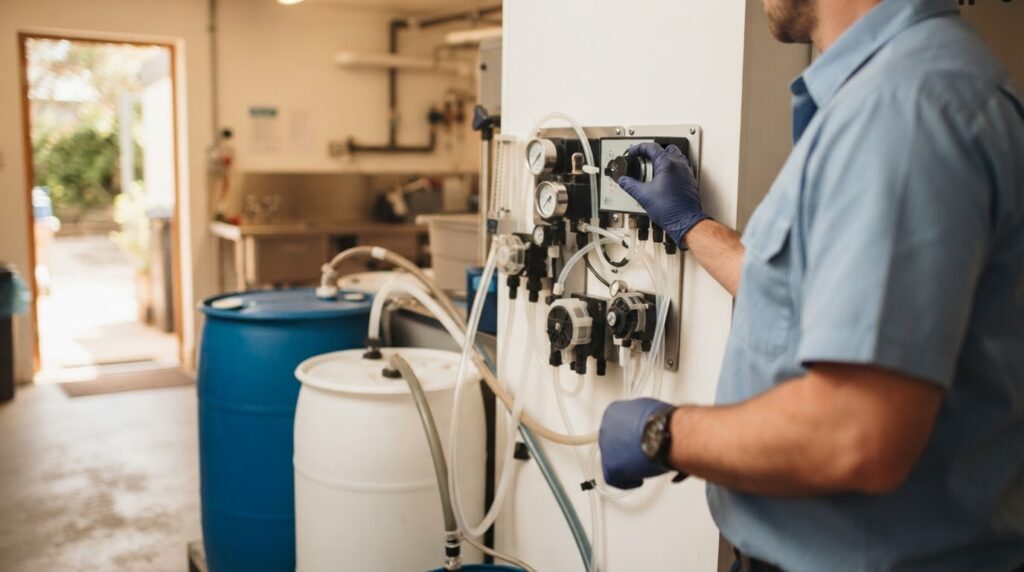
Dosing equipment does not hold its calibration forever. Pumps wear, tubing perishes, viscosity changes with temperature so a winter dose is not a summer dose. None of this is dramatic and all of it accumulates.
The way you catch it is by holding actual against expected per programme rather than per month. When a programme that should use a known volume starts using noticeably more across a week, you have a dosing problem, not a busy week.
Two things make that comparison possible. The wash programme needs to carry its expected chemical spend as part of the specification, alongside duration and pressure. And the actual has to be recorded against the wash so that a week’s worth of jobs can be compared rather than eyeballed.
Once that exists, a drift shows up as a line moving in your statistics rather than as a surprise on an invoice. We have seen a stuck dosing pump cost a site several hundred euros before anyone connected it to the drum they were replacing more often.

What a wash should cost in chemical
We are not going to give you a figure, because it depends on your chemistry, your water hardness, your vehicles and how dirty they arrive. Anyone quoting you a universal cost per wash is selling something.
What is portable is the structure of the question. Cost per wash breaks into three parts, and knowing which one you are looking at is most of the work.
| Component | What drives it | How often to review |
|---|---|---|
| Pre wash and detergent | Soil level, dwell time, water hardness | Seasonally, and after any water supply change |
| Main wash | Programme duration and dosing rate | Whenever a programme is edited |
| Drying agent and finish | Vehicle surface, customer expectation | Rarely, unless complaints appear |
The seasonal line is the one that surprises operators. Winter road salt changes what a pre wash has to do, and a dosing rate set in June is often wrong in January. It is worth a deliberate review twice a year rather than an adjustment when someone complains.
The rewash multiplier
A rewash is the most expensive event in a truck wash and it is almost never measured as one. It costs chemical twice, water twice, a bay slot that could have held a paying vehicle, and a customer who is now watching more closely than before.
What makes rewashes worth tracking is that they cluster. They cluster on a programme whose description promises more than its spec delivers, on a bay with a mechanical fault, on a shift, or on a vehicle type that needs a different approach.
Log the reason alongside the event. A rewash count on its own tells you that something is wrong. A rewash count with a reason and a bay attached tells you what to fix. Those two things are a week apart in practice.
Buying cheaper is usually the wrong lever
This is the part where we disagree with the obvious move. When chemical spend rises, the instinct is to renegotiate with the supplier or switch to a cheaper product. Sometimes that is right. More often it treats the symptom.
A cheaper detergent that needs a longer dwell time costs you bay minutes, and bay minutes are worth more than the saving. A cheaper product that leaves a film costs you rewashes, which multiplies rather than reduces. And a switch resets all of your baselines, so you lose the ability to tell whether the change helped.
Get the dosing right first and measure for a month. If the spend is still out of line after that, then negotiate, and you will negotiate from a position of knowing exactly how much you use rather than roughly how many drums you buy.
Questions we get asked
How often should dosing equipment be calibrated?
More often than most sites do it, and on a schedule rather than on suspicion. Quarterly is a reasonable starting rhythm, with an extra check after any change of product, any pump replacement, and at the start of the winter season when viscosity and soil levels both shift.
Should chemical cost sit on the package price?
It should sit in the margin figure behind the package, not in how you present the price. Customers buy an outcome. What you need internally is to know that the thorough wash carries its extra chemical and still earns more per bay hour than the standard one.
Is a concentrate always cheaper than ready to use?
On paper, yes. In practice it depends entirely on whether your dilution is accurate and stable. A concentrate dosed by a drifting pump can cost more than a ready to use product, because the saving assumes a precision the equipment is no longer delivering.
What is a reasonable rewash rate?
Low enough that each one is memorable. If your team cannot recall last week’s rewashes without looking, the rate is high enough to be costing real money and low enough to have become normal, which is the worst combination.
Can chemical cost be tracked per customer rather than per wash?
It can, and it is worth doing for large fleet accounts. A company account that mostly sends heavily soiled tippers costs more to serve than one sending clean distribution trailers, and if you price both the same you are cross subsidising without knowing it.
Want to see chemical cost sitting against revenue for every programme you run? Start a free trial and put a week of washes through it.